You’ve built a great product, sold it to your first set of delighted customers, and secured the funding or revenue to finance your early sales team. Now it’s time to decide who to bring on, and in what order. If you’re an early stage B2B tech company, here’s an org planning process to get you started. All you have to do is follow it exactly and everything will be perfect! Sound good? Let’s go.
Graduating from founder-led sales
Being ready to invest in a stand-alone sales team doesn’t mean you’re starting from scratch. During the seed stage, the founder hired one or more people to do the legwork while he or she identified the prospects and led the pitches. Now it’s time to build a home for those very early sales hires.
When you recognize the inflection point, you start looking for your sales leader. The level of that hire (director, VP, or CRO) should reflect your expected pace of growth, which is aligned with the funding. If your priority is to grow quickly (hello VCs!), bring someone on who can build and lead the team soup-to-nuts. If it’s most important to conserve cash, you might hire a director to lead a more narrowly defined team. In the rest of this article, I’m assuming the former. Therefore, this planning would be driven by a sales leader in collaboration with the founder/CEO.
Plan two years out and work backward
Make your short term hiring plan in the context of a long term hiring plan. The exercise can look like this: what should the team look like two years out, or to support X million in revenue? Then work backward and phase that team out in ~6 month increments.
The value of this exercise is that you know both the short term vision for the org and how it will come together to support the larger business goals. It’s a tool for communicating to the team and the board. And you can spare yourself from being in a continuous state of planning and hiring.
Here’s an example. It assumes a VP or CRO leading both sales and marketing, and addresses function rather than hierarchy.
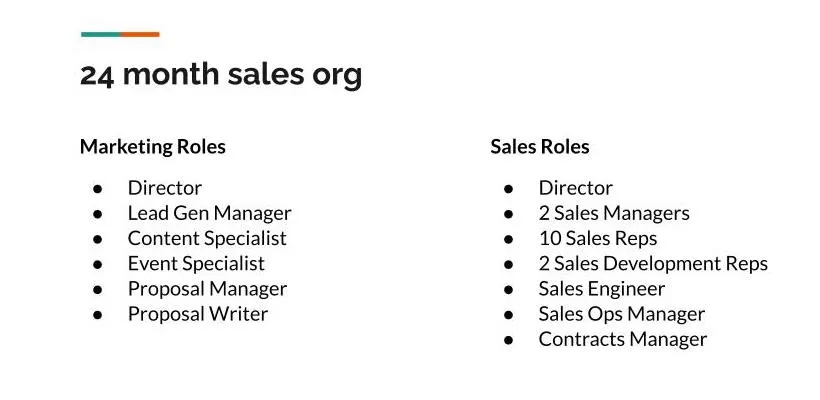
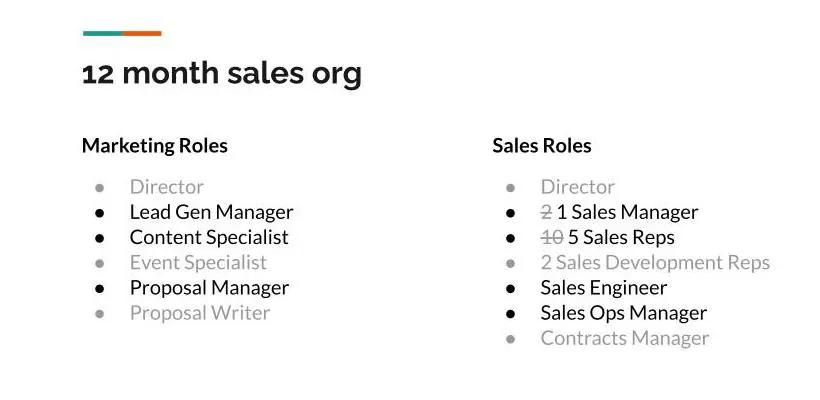
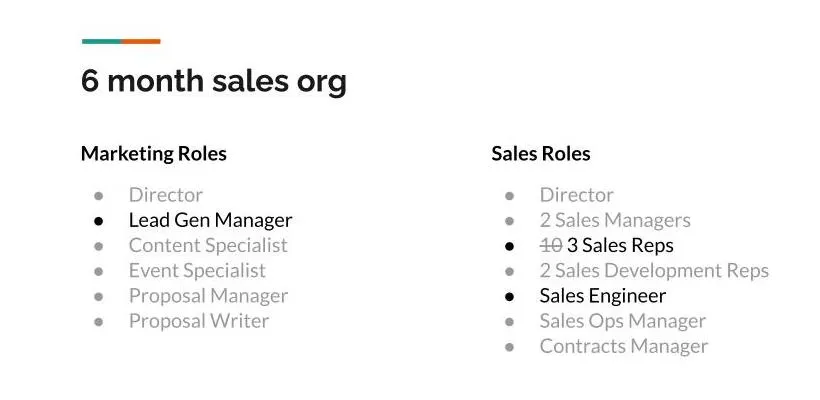
The key assumption informing your 24-month sales org: how much revenue will a fully onboarded sales rep close per year. Let’s say it’s a million dollars (congrats future you!). Then we should be planning on a team of at least 10 reps, hired and ramped by the end of year two, to achieve a forecast of $10mm in net new bookings in year three. And the reps don’t work alone, so we fill in the supporting positions based on what we think is required to sell our product in our market.
For reference, I’ll expose a few more assumptions, even though these will differ based on your sales process and market.
I would aim for any manager to have no more than 5 direct reports. That impacts the presence or absence of sales managers in each phase.
I’m assuming one sales engineer can support up to 10 reps.
When we introduce sales development reps (SDRs), we want at least one SDR to support five sales reps (1:5). In a future state, we might want one SDR for every two sales reps (1:2).
In general we need to build capacity on the team, but if there’s an open question about how many supporting positions are required per sales rep (or per opportunity), err on the conservative side and then layer on when you’re confident about the productivity and value of that role.
Finally, since this org chart is designed for a complex product with a long sales cycle, I would assume a 6 month ramp (aka onboarding period) to get a rep hitting steady state attainment. In other words, you hire them July 1, and in the following calendar year you assume that they can generate a million in bookings.
Choose your own adventure
The examples above are based on my experience selling mission critical software into (mostly) state and local governments and utilities. We had a long average sales cycle with multiple decision makers.
No two companies will need exactly the same team structure, even at a similar stage with a product of similar price and complexity. If you’re in an industry that doesn’t rely on Requests for Proposals (RFPs), you likely don’t need a dedicated proposal manager. If the product isn’t complex or feature heavy, you may not require a sales engineer.
In the same vein, there are roles omitted here that would be essential for some teams, based on their industry, product, and/or sales process. With that caveat, the next section covers some of the more common roles your team may require.
Key roles on the founding sales team
These are roles I consider fundamental in most early stage B2B sales organizations. The sales reps are the primary unit in that you must have enough to support your bookings target. And the other roles can be planned using a ratio of supporting role to rep. However, it should be clear from the sample org charts above and the comments below that in a formal sales org the reps don’t succeed or fail alone. Once you have a budget large enough to plan for a handful or more hires on the sales team, you layer in specializations in order to improve the efficiency of the overall team.
Sales Leader
Your Chief Revenue Officer or VP of Sales. Remember the chart you presented to investors that goes up and to the right? Now it’s this bozo’s problem. Just kidding, it’s our privilege. This person will be your right-hand man for formalizing the go-to-market strategy, positioning and pricing the product, rationalizing the forecast, and of course planning and hiring the team. As with all hires, think about who you need in this role for the next three years or so. You don’t need or want this to be the right person to lead sales after your IPO. We won’t get to the IPO if you don’t hire the right person for right now.
Sales Reps
These are your gritty, scrappy sellers. They can have whatever title is typical in your industry (e.g account executive), but these quota-bearing sales people will be responsible for guiding your prospective customer through the sales process and closing the deal.
They collaborate with your marketing people to shape the strategies and field test the messaging. In a complex and evolving sales process, they serve as a project manager for each opportunity. Pulling in the sales engineer and other subject matter experts in the company as needed.
I will devote another article to the qualities of early sellers, but in short, they need to be self-starters with relentless optimism who are comfortable with change and uncertainty.
Marketing Roles
What, I thought you said sales team?! Sure did. And marketing and sales should be inextricably linked at this (and every other) stage. Once you have a few sales people on the team you should be adding a marketing role to the team to work hand-in-hand with them.
For our purposes let’s simplify marketing roles into two categories. There are people focused on getting in front of your customers. Often called lead or demand gen. And then there are people focused on what to say when you do. Often called a content specialist. If you’re starting with just one person, they likely have a strength in one area or the other, but should be flexible enough to deliver what the team needs. Hire both and you have a lean mean team within another lean mean team.
In these early days, you borrow design skills from the product side of the house, or outsource, or hack it together.
Sales Engineer
The sales engineer is your translator between the front of the house and the back of the house. They specialize in setting up and giving demos, and in confirming the specs and scope of the implementation with the client. They marry the clients’ needs with your product and services.
This is most relevant for a complex and/or highly configurable product. It is profoundly helpful to fill this role internally, recruiting someone from the client services team over to sales. And really who doesn’t want to be on the sales team? It’s the best.
Sales Operations
You need it sooner than you think. Probably not in the first five hires, but certainly in the first ten. Like many of the roles we discussed, this one requires a person willing to wear a lot of hats and get their hands dirty.
They own the Customer Relationship Management system (CRM), the definition and exit criteria for your pipeline stages. The systems and processes they establish will yield the data necessary to shape and refine your strategy. Remember the staffing model you created to support X million in revenue? Now it belongs to your sales ops hire who is far more qualified to incorporate the variables we omitted in the first go round.
It Doesn’t Need to Look Pretty (And It Won’t)
When I was building a revenue team, especially the first time, I always wanted more tactical examples and advice from others who had been there before. I wouldn’t replicate something that worked for another company without careful consideration of our differences. But reading and hearing about other team configurations—even in different industries—helped me clarify my ideas and accelerate my planning.
The nature of early stage, high growth companies is barely controlled chaos. Do not stress over doing it right, there is no such utopia.
You will hire sales people before you have your pitch dialed in, or the marketing materials required for each stage of the sales process. Or you’ll create awareness and interest among your customers before you have the capacity and discipline to track and convert each of those opportunities.
That’s fine, it’s part of the game. Hire people who are up for the challenge, set their expectations accordingly, and you’ll figure it out together.
By Liz Fischer
Originally published on Series A-OK